

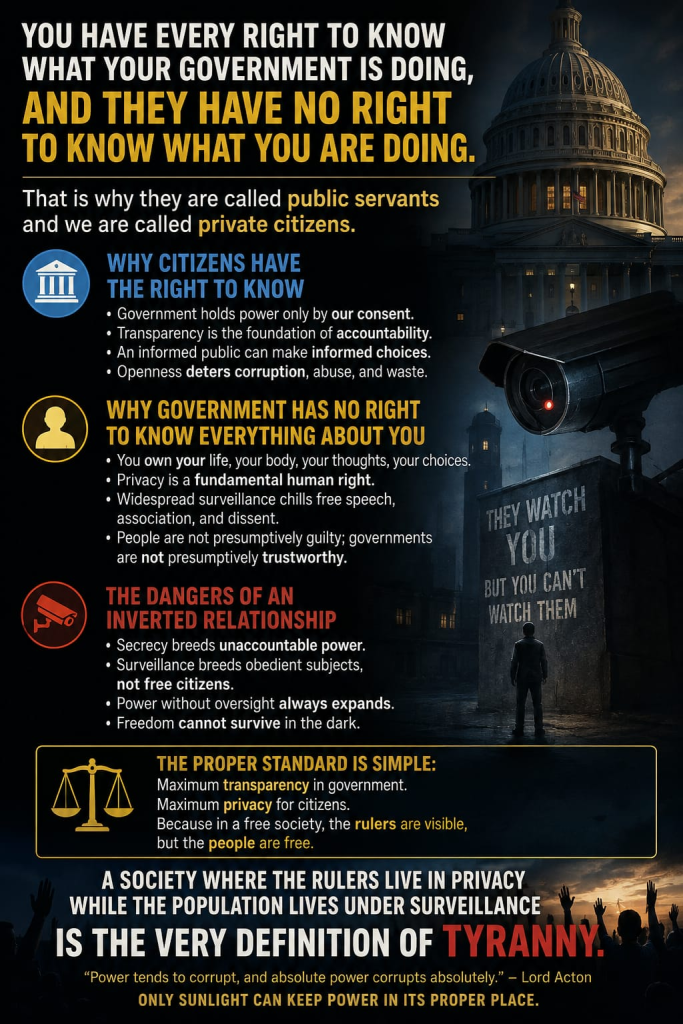
THE GOVERNMENT WORKS FOR YOU — NOT THE OTHER WAY AROUND
Let’s get one thing straight:
The government is not your owner. It is your employee. It does not possess political power because it is inherently superior to you. It possesses power because the people permit institutions to exercise power on their behalf.
That creates a fundamental asymmetry.
The people must be able to see the government. The government must not automatically be entitled to see everything the people do.
Why?
Because government has the power to compel, punish, tax, investigate, restrict, arrest and imprison. You do not have those powers over the government. That is precisely why government power requires more scrutiny, not less.
FOLLOW THE LOGIC
If officials can demand to know your finances, your movements, your communications, your associations and your activities—while you are told that their decisions, expenditures, communications, meetings and operations are “classified”—then the relationship has been turned upside down.
The powerful become invisible. The powerless become transparent. That is not accountability. That is asymmetrical power. And asymmetrical power without meaningful oversight is exactly the environment in which abuse flourishes.
“BUT WE NEED SECRECY.”
Of course some government information legitimately requires confidentiality. Military operations. Intelligence sources. Certain investigations. Personal information.
Nobody seriously disputes that. But there is an enormous difference between necessary secrecy and secrecy used to protect power from accountability.
“National security” cannot become a magic phrase that ends the conversation. Because once secrecy itself becomes sufficient justification for preventing scrutiny, the public is effectively being told:
“Trust us because you aren’t allowed to know enough to judge whether you should trust us.”
That’s backwards. A government cannot simultaneously demand the public’s trust and systematically prevent the public from examining the conduct that would justify that trust.
AND HERE’S THE REALLY UNCOMFORTABLE PART
The argument for mass surveillance often begins with:
“If you’ve done nothing wrong, you have nothing to hide.”
That’s a profoundly dangerous reversal.
The question isn’t: “What are you hiding?”
The question is: “Why does the government believe it is entitled to look?”
A free citizen does not begin from the presumption of guilt and then attempt to prove innocence. The state should have to justify intrusion.
Otherwise privacy ceases to be a right and becomes merely a privilege granted to people the government currently has no interest in examining.
And history should make us extremely uncomfortable with that idea.
PRIVACY IS NOT SUSPICION
Your private conversations are not suspicious simply because they’re private. Your movements are not suspicious simply because you don’t want them catalogued. Your finances are not suspicious simply because you don’t want strangers examining them. Your associations are not suspicious simply because you don’t want the state constructing a map of them.
Privacy is the space in which individual freedom exists before the state gets involved. Remove that space, and you don’t necessarily create safer citizens. You create more observable citizens. And those are very different things.
THE REAL TEST OF A FREE SOCIETY
Don’t ask whether the government says it respects your freedom.
Ask:
Who can scrutinise whom? Can citizens investigate government? Can journalists expose government? Can courts restrain government? Can parliament scrutinize government? Can citizens challenge government decisions? Can officials be held personally and institutionally accountable?
And, critically:
Can the government secretly accumulate enormous information about ordinary people without meaningful independent oversight?
Because if the people are permanently visible to the state while the state becomes increasingly invisible to the people, you’ve created the wrong direction of power.
THE PRINCIPLE IS SIMPLE
Maximum accountability for public power. Maximum protection for private life. Not because government is inherently evil. Because power is dangerous precisely because it can be used by people who are not you, may not share your interests, and may not remain in office forever.
Today’s government might be friendly. Tomorrow’s might not be.
The surveillance infrastructure built for one administration does not magically disappear when another takes power.
So don’t ask only: “Do I trust the people running it today?”
Ask:
“Would I trust this same machinery in the hands of my worst political enemy?”
If the answer is no, you’ve just discovered why safeguards matter.
THE BOTTOM LINE
A citizen should never have to live under the principle: “Prove that you deserve privacy.”
It should be the government that has to prove that its intrusion into private life is lawful, necessary, proportionate and accountable.
Because the moment the state demands transparency from the population while shielding itself from scrutiny, the relationship between citizen and government has been inverted.
The rulers watch the people. The people are forbidden from watching the rulers.
That is not the architecture of liberty. That’s the architecture of control. A free society should operate in the opposite direction: The government sits in the glass house.
The citizen gets to close the curtains.
Because public power belongs under the light.
And private citizens belong in freedom.